
In the nicotine glory days, 4 out of 5 doctors smoked Camels. At least, that was the claim of the advertising campaigns.
Camels were also smoothest on the stomach.

Storytelling helped hook people on cigarettes, and storytelling (and resulting peer pressure) changed smoking habits.
Humans aren’t data-driven. Facts alone don’t make people care about _[anything]_.
Think that’s too far? Take a moment and try thinking of an example.
Safe and inviting streets should be a bipartisan issue. Instead, America’s two major political parties debate funding sources while overlooking a crisis.
Traffic crashes are a public safety crisis that American culture takes for granted. Every year, over a million people die in traffic-related crashes around the world.
In the U.S., traffic deaths are the equivalent of a 9/11 every single month.
Let that sink in for a moment.
The worst part is that most traffic deaths are preventable by changing the way roads are planned and engineered.
Fight against the terrorism of poorly engineered streets.
Sweden believes no loss of life is acceptable. That’s the heart of their Vision Zero initiative. Take a look at the short video below.
Traffic safety campaigns like Vision Zero have everything to do with storytelling. If scientific data was enough to change behavior, a state of emergency would’ve been declared decades ago.
Every presidential administration incorporates public safety into campaign speeches and policy platforms.
Changing basic assumptions of road design is a tangible way to save lives. Tens of thousands of lives each year.
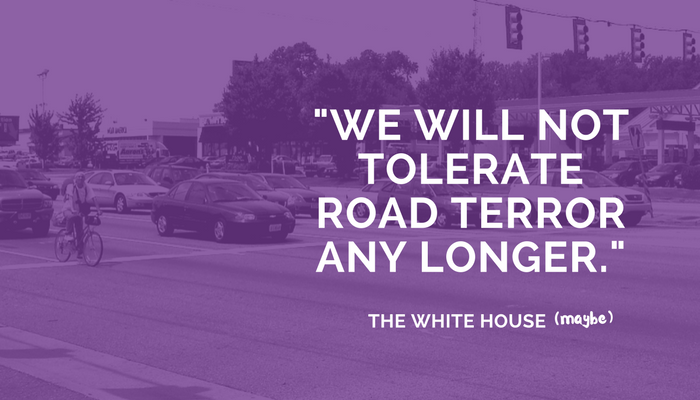
People need to be alerted to the clear and present dangers of modern American road design.
Simple stories to the rescue. Use plain language that gets straight to the point.
You must be logged in to post a comment.